Lesson 30
Simple Sanskrit – Lesson 30
An important aspect of procedure of detailing विग्रह of a समास is to first get to the bare minimum form of the compound word. The bare minimum form is often the form in प्रथमा विभक्ति.
For example first word in first verse in गीता is धर्मक्षेत्रे. This is of course a compound word. But the form धर्मक्षेत्रे is सप्तमी विभक्ति एकवचनम् of the noun धर्मक्षेत्रम्. So we should do विग्रह of the word धर्मक्षेत्रम् and not of the formatted word धर्मक्षेत्रे.
This may not be always necessary, especially if the word is already in प्रथमा विभक्ति. That was the case for बाह्योद्यानस्थितहरशिरश्चन्द्रिकाधौतहर्म्या.
Words like प्रतिदिनम्, साश्चर्यम् also are already in प्रथमा विभक्ति.
But doing विग्रह of a समास would need being conscious of the meaning intended to be conveyed.
Note प्रतिदिनम् = every day साश्चर्यम् = with wonder. “Every day” would be an answer to a question “When ?” Similarly “with wonder” would be an answer to a question “how ?” So प्रतिदिनम् and साश्चर्यम् have an adverbial intent, which in Sanskrit is called as अव्ययीभावः
विग्रह of a समास is primarily an exercise in detailing the meaning of the word. And विग्रह should do that.
विग्रह of प्रतिदिनम् is detailed as दिने दिने.
विग्रह of साश्चर्यम् is detailed as आश्चर्येण सह.
अव्ययीभाव-समास-s are another type of समास-s.
Both these words प्रतिदिनम् and साश्चर्यम् have a prefix उपसर्ग. In detailing विग्रह of प्रतिदिनम् as दिने दिने what is detailed is really the meaning lent by the prefix प्रति. Likewise in detailing विग्रह of साश्चर्यम् as आश्चर्येण सह, what is detailed is really the meaning lent by the prefix स. So in these words, the prefixes are almost like component words पद-s of the compound words.
Need to be conscious of the meaning intended can be explained also by considering a word विमलम् in two different sentences – (1) विमलं वस्त्रं धारय Wear a clean cloth (2) वस्त्रं विमलं क्षालय Wash the cloth clean.
As can be seen, in विमलं वस्त्रं धारय, the word is adjective of the noun वस्त्रम्. In the other sentence, it is adverb of the verb क्षालय. Should we do different विग्रह for the same word ? My answer would be ‘Yes’. Basically some people may question whether every word, which has a prefix उपसर्ग and a noun नाम, should be treated as a compound word. Again, my answer would be ‘Yes’. I say so with the basic premise in mind, that विग्रह of a समास is primarily an exercise in detailing the meaning of the word.
In विमलं वस्त्रं धारय I would decipher the विग्रह as विगतः मलः यस्मात् तत् (बहुव्रीहिः)
In वस्त्रं विमलं क्षालय I would decipher the विग्रह as विगतः मलः अस्मात् तथा (बहुव्रीहिः)
Even if one should be conscious of the meaning intended to be conveyed, it is important to be open-minded and receptive to different meanings likely to be derived by different विग्रह of a given समास. Another person may think of a different meaning. Why not grant it ?
For example, in the word धर्मक्षेत्रम्, धर्म = ?? क्षेत्रम् = field. Note, I am mentioning “धर्म = ??” Do we not know the meaning of the word धर्म ? We do, but the word has many, many shades of meaning. One common meaning of धर्म is religion. But what is ‘religion’ ? It is a challenging question to answer.
I would rather go by the meaning धर्म = righteousness. So धर्मक्षेत्रम् = field of righteousness.
Now, what can make a battlefield a field of righteousness ? Possibly there was history associated with that particular battlefield, that in any battle fought there, only that side prevailed, which had righteousness with it. The battle between पाण्डव-s and कौरव-s was also to be fought to decide, which side had righteousness. Because of its past history the battlefield had come to be known as धर्मक्षेत्रम् = field of righteousness.
Rather, since the battle was to be fought to decide which side had righteousness, it was the field (for) decision about righteousness. The word धर्म has this other shade of meaning as धर्म = justice. Then we can say धर्मक्षेत्रम् = field (of) righteousness OR field (for) justice about righteousness.
Since the two prepositions ‘of’ and ‘for’ connote षष्ठी and चतुर्थी विभक्ति-s respectively, विग्रह of धर्मक्षेत्रम् can be धर्मस्य क्षेत्रम् OR धर्माय क्षेत्रम्.
On that battlefield there was also the person whose name was धर्म. Being a battlefield, there were two parties and there was the allotted field for each party. So by another meaning of क्षेत्रम् = domain, meaning of धर्मक्षेत्रम् becomes “the domain of the person whose name was धर्म”. So even by the विग्रह as धर्मस्य क्षेत्रम्, there can be two meanings of धर्मक्षेत्रम् – (1) धर्मक्षेत्रम् = field of righteousness (2) धर्मक्षेत्रम् = domain of the person whose name was धर्म.
विग्रह-s of समास-s make Sanskrit literature very engaging and enjoyable, revealing, refreshing and vibrant, especially when one gets to derive a range of meanings from the same given words.
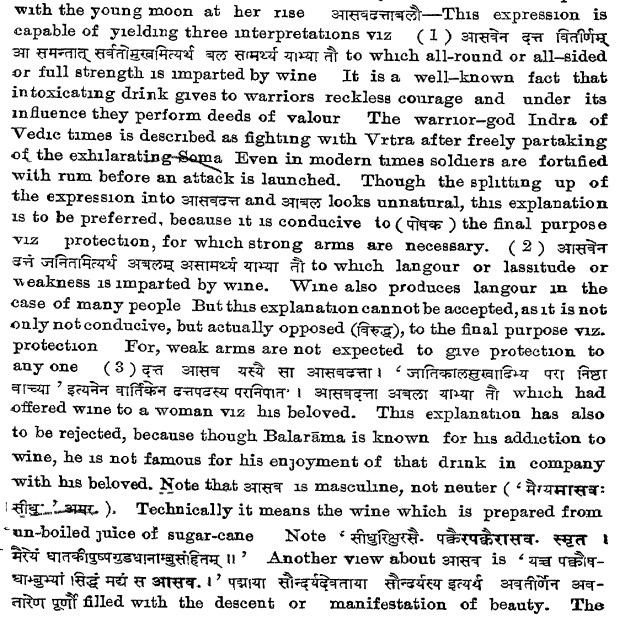
The drama स्वप्नवासवदत्तम् by भास opens with सूत्रधार briefing the audience of the main characters of the drama. For that briefing, the सूत्रधार sings a श्लोक, which has a compound word आसवदत्ताबलौ. This word can have three different meanings ! In the panel below can be seen an excerpt, giving all the three interpretations, as detailed by Shri. A. B. Gajendragadkar, the then Professor of Sanskrit in Elphinstone College, Mumbai, in his book published in 1938, downloaded by me from the internet.
 * * |